Friday, August 19, 2016

Farm Percussion (Study 10: 1939 Farmall International)


This video above premiers a first-attempt of tractor music for an inaugural event in Queensland, Australia.  These two instrumentalists and their '39 Farmall, aka "Mongrel" were preparing for "Tractor Tattoo 2012," a community arts and cultural project celebrating the transformation of an old tractor into a playable musical instrument in Kingaroy.

Here's a view of the festivities:


Video by Clive Lowe


Spring Work Out
J. Ann Brodland

Friday, July 29, 2016

Amidst the Reaping Season


Rev. Patrick Bell (1799-1869)

Patrick Bell, a member of the Scottish clergy, was an inventor and a famer's son.  In 1826, he invented his reaping implement which was the first practical mechanical reaper designed in Britain.

Bell's Reaper
Artist:  Sheila Terry

It was mounted on two wheels and pushed by draft horses.  The grain was cut and gathered together before the horses could trample it.  The modern day combine harvester is based on the combination of Patrick Bell's Reaper and Andrew Meikle's Thresher.

Bell's Reaper

Cyrus Hall McCormick (1809-1884)

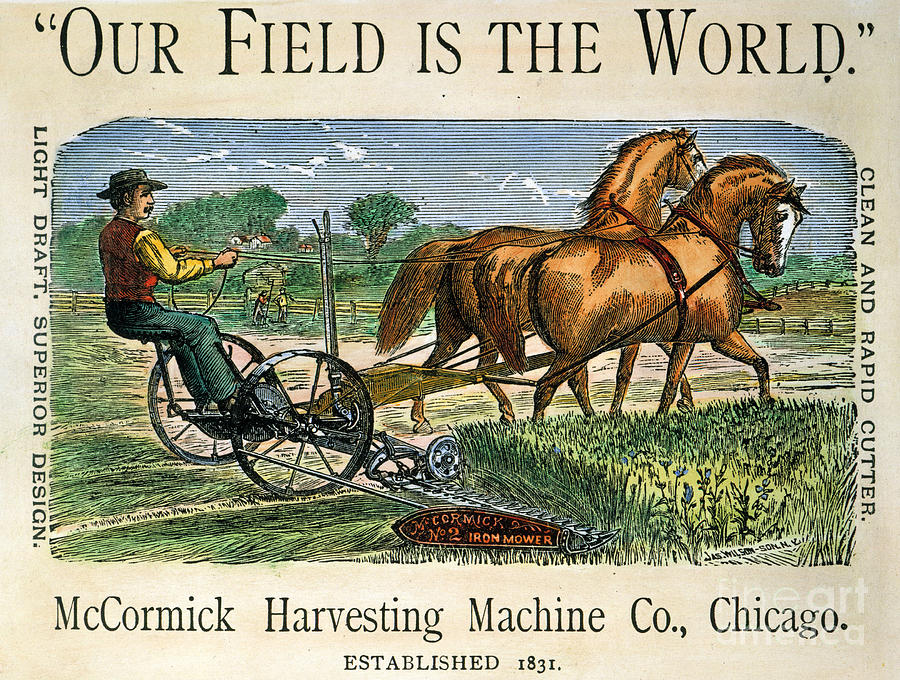
McCormick was the eldest son of Robert McCormick, farmer, blacksmith, and inventor, born in beautiful Rockbridge County, Virginia. With limited education, he spent all of his time in his father's workshop.  

McCormick's Reaper

Cyrus (at 22 years of age) tried his hand at building a reaper in 1831.  It was pulled (rather than pushed) by draft horses and consisted of a vibrating cutting blade, a reel to bring the grain within its reach, and a platform to catch the falling grain.  The center wheel spun and the paddles pushed the crop onto a moving cutter bar and knife.  McCormick patented his invention in 1834, made his first sale in 1840 and moved to Chicago in 1847 to begin large-scale production.  He was convinced that the vast fertile land of the Midwest would serve as a better setting for his reaper than the rocky, hilly East. The six million harvesters he manufactured opened the prairie lands to intensive agriculture, a major factor in America's prosperity.  In 1902, McCormick Harvesting was joined with other companies to form the International Harvester Company.

McCormick's Reaper
Photo:  Science Photo Library


Obed Hussey (1792-1860) was born to a Quaker family in Maine.  He was a tireless inventor and gained fame when he patented the first working reaping machine in 1833.

Hussey's Reaper (1838-1845)
Lithograph:  Ed Weber & Co., Baltimore, Maryland
(Precursor to A. Hoen & Co.)

Manufactured by the Patentee in Baltimore, Maryland, this reaper was, "Warranted to cut fifteen acres of heavy wheat in a day, the grain taken as clean and left in as good order for binding as when cut by the scythe or sickle."  Further notoriety followed Hussey due to the long rivalry with McCormick for the improvement and sale of reapers in the U.S.  This was a contest McCormick eventually won in 1858.


Some Antique Hand Implements
Machete (Ontario Knife Co.), Sickles (2), Draw Knife (Bridge Tool Co.)


When the historian of the future comes to speak of the great Americans . . . who have succeeded the best in lightening the burdens of mankind, by the side of Franklin, and Fulton and Joseph Henry and Morse, they will not forget to mention Cyrus H. McCormick.  Where the golden wheat rustles in the breeze, the panting toilers under the hot sun will hail him as their benefactor.
~ S.C.P. Miller, In Memoriam:  Cyrus Hall McCormick


.•°*”˜˜”*°•.˙·٠•● Ƹ̵̡Ӝ̵̨̄Ʒ ●•٠·˙.•°*”˜˜”*°•.


Monday, July 11, 2016

2016 Calgary Stampede - Winner of the World Championship Six Horse Hitch Competition

2016 World Champion Six Horse Hitch
Photo:  Show Champions

Today was the final day of the Heavy Horse Show at the 2016 Calgary Stampede.  Brian and Colleen Coleman of Eaglesfield Percherons presented the Mark Messenger Memorial Hitch of Cheyenne, Wyoming.  The Eaglesfield Percheron crew brings the Messenger hitch first place wins in Percheron Team, Percheron Unicorn, Four and Six Horse Hitch, and the World Championship Six Horse Hitch Championship.  This year was Coleman's seventh World Championship win. 

Click Photo Above ~ Stampede Blog, Madeline Babinec

We thank the crew for all their efforts, and the Messenger family for entrusting us with their talented and hard working Percherons as the 2016 show season launches in Canada.


2016 Championship Buckle

Last year, the Calgary Stampede interviewed Brian for their blog as to what it takes to prepare a hitch for competition.  That interview can be read by clicking the working horses below.


Getting Work Done While Working Together
Photo:  J Ann Brodland

•.¸✽✽¸.•


Friday, May 13, 2016

New Edibles for the 2016 Stampede!


Yet another reason to look forward to Stampede Days. . . . Thank you Stampede Blog for giving us the heads up on the smorgasbord of delicacies -- and those of possibly avoidable interest!!  Click on the luscious "Saturday Morning Beaver Balls" for more details on this delectable edible and the other 33 menu items hitting the 2016 midway . . .

•.¸✽✽¸.•


Saturday, May 7, 2016

Dead Man Riding - Sweet Kiss of Death on Derby Day


Frank Hayes (1888-1923)
Sweet Kiss, Owned by Miss A.M. Frayling
June 4, 1923

Frank Hayes, a stable-hand and trainer by profession, was convinced that the ol' mare could win a race. Maiden steeplechase mare, Sweet Kiss, was not a favorite of her owner, Miss A.M. Frayling.  The owner allowed Hayes to have his day and lined Sweet Kiss up for the two mile, 12-jump race at Belmont Park, sporting 20:1 odds.

They ran and she won by a head.

The overjoyed trainer and owner approached to lead Sweet Kiss to the Winner's Circle, and discovered that Hayes was dead, right there, after he dropped out of the saddle, lifeless. He suffered from a heart attack that killed him sometime in the latter part of the race. Since Hayes stayed on her back the entire race, Sweet Kiss was declared the winner, and he is the only jockey to have won a race after death and who had an undefeated record. 

Hayes' death by heart attack was theorized to have been brought on by Hayes' extreme efforts to meet the weight requirements, and possibly followed by the fact that he was winning by the New York Times.  The spectators thought that Hayes was showboating his win, slumped over and riding with one hand, "relaxed as a dog sleeping in front of a fireplace."  

Hayes was buried in his colorful silks three days later.  There wasn't a jockey that would ever race Sweet Kiss "of Death" ever again.


Saturday, April 30, 2016

Somebody Get Me An Ambulance!


Ohio State Veterinary Hospital Ambulance (1914)


Courtesy:  The Military Horse Society


Image from Otis Archives, from the Army Medical Museum

The use of animals in WWI for both transport and combat was so integral to both sides, that in the end, over 8 million horses died on both sides.  Maintaining the animal forces was crucial, and over 2.5M horses were treated in veterinary hospitals before being able to return to active duty. 


Canine Ambulance, New York (1900)
The Dog. Management in Health Treatment in Disease, Dr. S.K. Johnson
(Back Cover)

Early dog hospitals often had ambulances too since urban pet owners had no way to transport their sick or hurt animals to the clinic. 


Thursday, April 21, 2016

Legendary Loss


Prince Rogers Nelson
(1958-2016)
Last Live Show, The Fox Theater, Atlanta, Georgia


Monday, April 18, 2016

Otto's Percheron

De Percheron (1898)
Otto Eerelman (1839-1926)

A skilled draftsman, watercolorist, and painter, Eerelman was born in the Netherlandish village of Groningen in 1839, where he studied with the Dutch history painter J.H. Egenberger.  He later studied in Paris in 1867 and in Brussels from 1874-1876.  After living in The Hague and Arnhem for years, he returned home to become an instructor at the Minerva Academy where he previously studied with Egenberger. Eerelman was well known for his detailed renderings of horses.  His "De Percheron" was part of the Dutch edition of "Paardenrassen Kunstalbum" a portfolio of plates based on Eerelman's paintings, depicting different breeds of draft horses.

Otto Eerelman
Self-Portrait

To see and appreciate more beautiful horse portraiture by Otto Eerelman, click on his portrait above.


Tuesday, March 22, 2016

Rittenhouse Stables, a Peek into Old Philadelphia in the 1800s.

Photo:  Phillymag.com

Rittenhouse Square is one of William Penn's original five open-spaced parks that he and his surveyor, Thomas Holme planned during the late 17th Century in central Philadelphia.  Originally known as the Southwest Square, this square became surrounded by brickyards as the area's clay terrain was better suited for kilns than crops in the 1700s.  In 1825, the square was renamed in honor of David Rittenhouse (1732-1796), a descendant of the first paper-maker in Philadelphia, who was a brilliant astronomer, clock-maker, and patriotic leader of the Revolutionary era.

Rittenhouse Square has always denoted quality.  The first house facing the square was built in 1840 at 1811 Walnut Street (click to see) by James Harper, a merchant and brick manufacturer who had recently retired from the U.S. Congress.  He bought up most of the north frontage and subdivided the property into generously proportioned building lots.  The 2000 block of Rittenhouse Square was the address for the neighborhood's equine transport.  The Harper House became the home of the exclusive Rittenhouse Club in 1901.  

There was a building boom in the 1850s.  In the second half of the 19th Century, the Rittenhouse Square neighborhood became the most fashionable residential section of the city, and home of Philadelphia's "Victorian aristocracy."  Some mansions still survive the streets facing the square, although most of the grand homes gave way to apartment building living after 1913.

Photo:  Plan Philly.com, WHYY & Newsworks.org

Rittenhouse Square Stables still stand at 2023-2025 Rittenhouse.  A beautiful terra cotta horse head pokes out from the arch above the second story loading doors.  The building was erected around 1881 as a three-story brick "messuage" according to the historical files and was developed into a stable and coach house in 1884.  There was also a stable at 2049 Rittenhouse that was built in 1870.  In the 2023-2025 stable, larger doors were put into place to enable vehicles to go in and out since the stable had become a garage for the more affluent residents.  This building does not have a history of being a firehouse. Citations had been issued due to the owner allowing the stable to deteriorate since the 2000 block is part of the Rittenhouse Fitler Residential Historical District, designated in 1995.  Loose walls, missing bricks labeled the building "unsafe" in 2010.  And later on complaints that significant and unique brick and brownstone cornice deterioration was taking place, an issuance of maintenance code violations and demolition by neglect was put into place.  

Façade Shoring in Preparation for Demolition
Photo:  James Jennings

In September, 2015, a flurry of construction activity as preservation / refurbishment of Rittenhouse Square Stables began to take place by contractor, Bottos Construction, out of Broomall, Pennsylvania.  The former stable, located at 2023-25 Rittenhouse Square near 20th Street, made of terra cotta and intricate brick work, is in the process of becoming six apartment units.  Other neighboring stable row buildings fared much better through time.  The former carriage houses at 2036 and 2040 were transformed into beautiful homes, with entrances and other features that retain the character of their original use.  In the 1920s, the stable at 2049 (click to see) Rittenhouse had a renovation, transforming the carriage entrance into a French-style storefront.  This was keeping with the times when the street became a more fashionable shopping corridor.  The second story loading door and pulley support remain, but needs a 21st century restoration.


We look forward to seeing the finished façade and maybe see an example of the dwellings from Bottos Construction, and will share.