This video above premiers a first-attempt of tractor music for an inaugural event in Queensland, Australia. These two instrumentalists and their '39 Farmall, aka "Mongrel" were preparing for "Tractor Tattoo 2012," a community arts and cultural project celebrating the transformation of an old tractor into a playable musical instrument in Kingaroy.
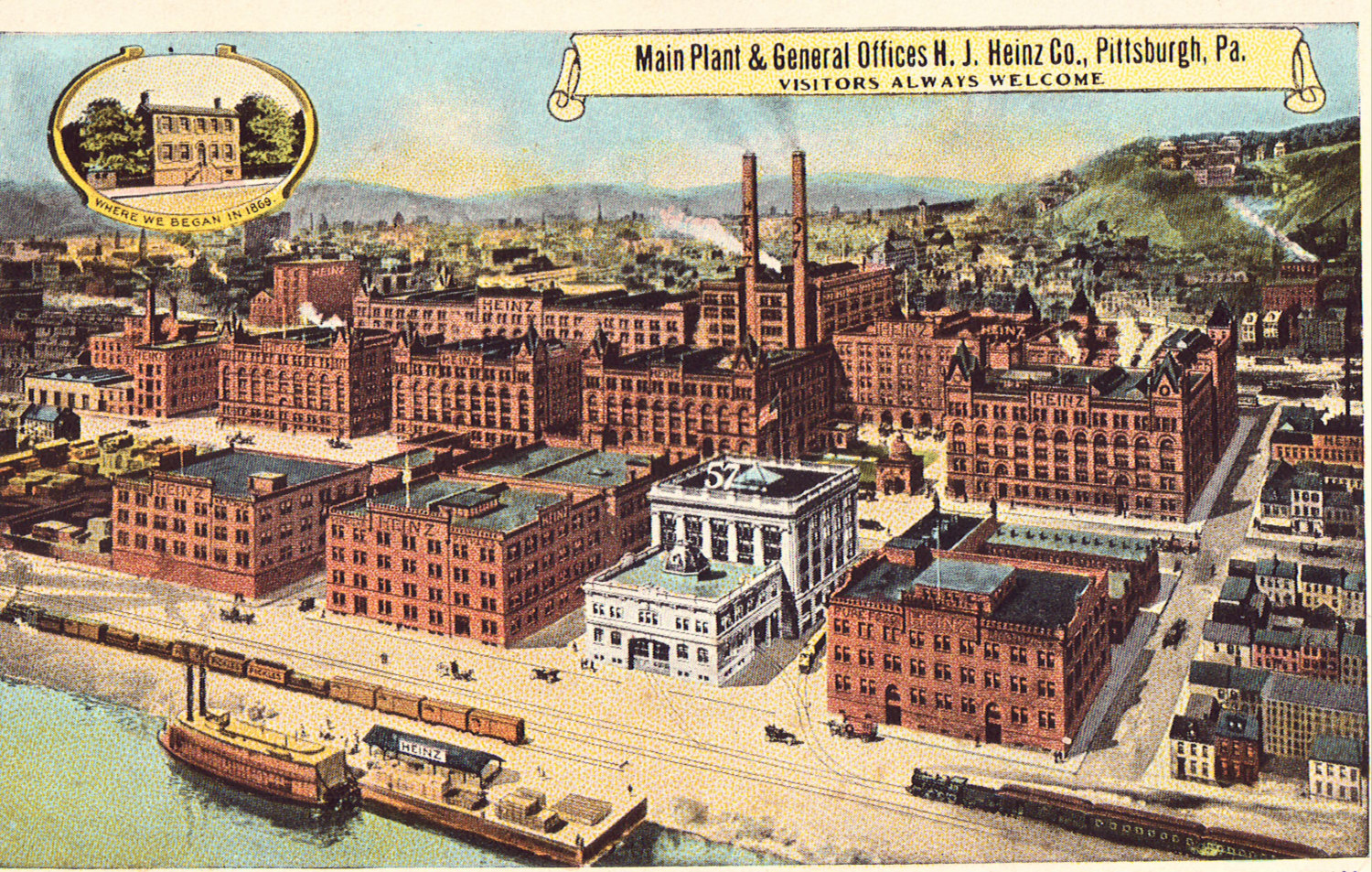
Library & Archives, Senator John Heinz History Center
In the early 1870s, the H.J. Heinz Co. operated out of a two-story Sharpsburg farmhouse along the northern edge of Pittsburgh. They delivered their products by horse-drawn wagons.
Henry J. Heinz was born in Pittsburgh in 1844, of German ancestry. He began his life-long food business career -- not with pickles or ketchup -- it was with horseradish.
Heinz was still a boy when he began bottling and selling "Heinz Horse Radish" using a keystone-shaped label representing the Keystone State of Pennsylvania.
Henry J. Heinz on Horseback
Credit: Historical Society of Western Pennsylvania
In 1869 Heinz got married, and partnered in business with L.C. Noble. They bottled Anchor Brand food products at the Heinz homestead, which became their headquarters. Their quick growth of establishing branches in Chicago and St. Louis caused Heinz and Noble to go bankrupt in 1875. In 1876, Henry and two of his brothers "got back on the horse" and started all over again as F. & J. Heinz Company, getting their head-above-water financially in 1879.
In 1888 the company changed its name to H. J. Heinz Company and moved forward in building their "Heinz Complex" in Allegheny City, Pennsylvania. During this time, H. J. Heinz Company produced chili sauce, mincemeat, baked beans, tomato sauce, macaroni and
spaghetti with cheese, fruit butters, piccalilli, currant jelly, cherry and pineapple preserves, Worcestershire sauce, mustard dressing and other preparations. Presently, the Heinz Company manufactures thousands of food products in plants on six continents, and markets these products in more than 200 countries and territories.
The company has used its "57 Varieties" slogan since 1896, even though there were already at 60 products at that time.
The Heinz Company's distribution was well-known and recognized due to its elegance of delivery service. The horses were pure black Percherons, bred originally as warhorses rather than draft horses. The horse-drawn delivery wagon was usually painted white with green trimmings, carrying boxes of Heinz products.
Delivering Pickling Barrels, Pittsburgh, PA (1888)
Photo: From E. Willard Miller, Keystone to Progress, An Illustrated History
Windsor Publications (1986)
The quality of the horses was demanded in that the company's name was associated with the presentation of the delivery years ago, and then again in its exhibition hitch of recent years.
Heinz Hitch Postcard (1989)
The horses needed to be well taken care of, happy, well-shod and clean, bringing recognition to the brand name. Heinz demanded that his horses maintained a certain conformity in weight, size, type and color, and they were housed in his stables which were known as their "equine palaces."
H. J. Heinz Company had over 150 teams of Percherons operating out of its Allegheny City facilities. From 1894, Heinz Company shipped vinegar and pickles by means of rail.
Heinz was one of the first industrial employers of women who worked in a spotless factory. Their physical and moral welfare was carefully guarded, as "The Heinz Girls" had their medical and dental bills covered by the company.
Labeling Machine (1901)
Photo: Historical Society of Western Pennsylvania
Library & Archives, Senator John Heinz History Center
The Heinz Hitch was used for marketing and was seen in parades around the United States and Canada from 1984 (debuting at the Pittsburgh Labor Day Parade). Dalmatians (one was appropriately named "H.J." back in 2002) and "Susan Pickles," a bleary-eyed Basset Hound, accompanied the hitch throughout the exhibition years. The harness was handcrafted by the Amish in Central Ohio in patent leather with all chrome hardware and fittings, weighing approximately 74 pounds each set. Unfortunately, the company's officials announced in May 2007 that they could not keep spending $500,000 annually on a program whose marketing impact was difficult to measure.
"The decision to cease funding of the hitch was one that Heinz wrestled with for a number of years." With that, the company notified John Dryer (whose family owned the hitch operation and stabled the horses on its Washington County farm) and the sponsorship ended. Heinz agreed to fund the appearances already agreed to and on the books for 2007.
John Dryer
"Nothing lasts forever in this age." "I've been all over the world with the hitch, but my wife hasn't. It might be time to show her some of it."
Mr. Dryer worked for Heinz for 32 years, retiring in 1992 from his position as General Manager of Research and Product Quality Assurance.
Click and watch the Heinz Hitch exhibition at
Spruce Meadows in Alberta in 2003
Heinz History Center
Pittsburgh, Pennsylvania
The Heinz hitch wagon is a 6,800 pound antique Studebaker that traveled 57,000 miles a year over two decades promoting the Pittsburgh condiment-maker's products. The wagon was found uncovered in a roofless shed in central Pennsylvania in 1978 with a tree growing up through its bed. Built in Indiana in the 1850s, shipped to the east coast by rail, this same wagon hauled Heinz products around Philadelphia at the turn of the last century. Heinz purchased it in 1986, and two years later, spent $22,000 to have it refurbished by expert craftsmen. It took more than six months and 19 coats of paint on the initial refurbishment, and received only one more complete face lift in 1998. This heavy-duty hitch wagon served as the "tandem" trailer trucks of their time. Its home is now in The Senator John Heinz History Center, an affiliate of the Smithsonian Institution, and the largest history museum in Pennsylvania. The H. J. Heinz hitch "wowed" the crowds through the years at five Rose Bowl parades, the Calgary Stampede, and countless county fairs, exhibitions, Fourth of July and other holiday parades.
Horse Drawn Caisson at Arlington Cemetery
Passing Christmas Wreaths
Photo: Don Harper
In August of 2007, The H.J. Heinz Company formally announced that it would donate its hitch horses to the 3rd U.S. Infantry Regiment (The Old Guard) where they were used to pay homage to fallen soldiers (and former Presidents and other statesmen) at Arlington National Cemetery. This ensured that the horses would be well cared for throughout their lifetime as they participated in some of the eight full-honor military funerals per day in Arlington while living at Fort Myer, adjacent to the cemetery.
Fort Myer, Virginia traces its origin as a military post to the Civil War. In 1887, Gen. Philip H. Sheridan, the Army's commanding general, decided Fort Myer should become the nation's cavalry showplace. The cavalrymen moved in, including the 3rd Cavalry Regiment, supported by the 16th Field Artillery Regiment, and the communications people moved out. Fort Myer became home to as many as 1500 horses from 1887 to 1949, and horse care was of utmost importance then and now.
All of the horses at Fort Myer have a full-time dedicated caretaker and veterinarian, and more than 40 other horses for company. Those other horses in the stable have various honor duties, including taking part in therapeutic riding programs for injured military personnel.
In February 2013, the Heinz Company was eventually sold to Warren Buffet's Birkshire Hathaway and 3G Capital for $23 billion dollars. Other product lines that you might recognize and might not know are Heinz products include: HP Sauce, Lea and Perrin's sauce, Ore-Ida and Tater Tots potato products, TGI Friday's, Weight Watchers, and several others brands.
On an interesting note: For many years, Heinz supplied McDonald's with ketchup. In October 2013, McDonald's ceased this relationship after 40 years, and decided to transition business to other suppliers. This was due to the then-recent management changes where 3G Capital (part-owner of Burger King) / Heinz hired the former Burger King CEO, Bernardo Hees, as president of Heinz. However, many McDonald's locations overseas still use Heinz Ketchup.
"To do a common thing uncommonly well brings success." ~ H.J. Heinz
A motto to strive to live by, here at Eaglesfield Percherons.
Thank you for all the fabulous well-wishes for our win of the Open Six of the North American Six-Horse Classic Series competition with the Mark Messenger Memorial Hitch. The 2016 Big Thunder Draft Horse Show was terrific, and we appreciate being chosen as "Fan's Choice" on Friday night. Onward to compete at the National Western Stock Show in Denver this weekend. We're already missing Big Thunder's heated barn!
Capt. Frederick Pabst and his son, Frederick, provided an influential presence in the Percheron business in the United States in the late 1800's. Best's Brewery was one of the predecessor companies of Pabst that utilized three working horses to grind malt. In 1847, Best contacted his family in Germany desiring to purchase another horse to make deliveries in both town and country. In 1859, Capt. Pabst married Maria Best, sold his shipping interests and took a partnership with Best's father in the brewery in 1863. Best retired in 1867 and Capt. Pabst and Schandein (sister-in-law's husband) transformed the company into one of the nation's largest breweries.
Pabst Brewery capitalized on the devastation of the Great Chicago Fire that destroyed 19 Chicago breweries. By 1870, Best Brewery had more than 20 horse-drawn wagons. Best would "flash mob" the streets of Milwaukee, parading all the wagons loaded with beer at the same time to the shipping depot for a big visual marketing impact. After the death of Shandein in 1889, Pabst, as president, changed the name from Best Brewery to Pabst Brewing Company.
In 1906, Fred Pabst purchased the entire stud of the Little Missouri Horse Co. located in North Dakota, bringing along approximately 1,000 suckling colts that carried three or four fine crosses of Percheron blood. There were also 150 purebreds with more than 30 mares retained in the stud, proving to be good breeding stock. Pabst also purchased horses from Hagemeister Stock Farm, H.D. & F.A. Reed, the Hartman Stock Farm and other small breeders in Wisconsin.
Over 800 geldings were employed at the Pabst Brewing Co., of Milwaukee. Fred Pabst had proven that Percheron geldings were the most satisfactory heavy horse workers in the cities. This photo (above) was taken in 1901 in front of Pabst's home.
Practically all the horses purchased by Pabst were high grade Percherons, and it was decided that a four-horse hitch would be exhibited at the 1904 World's Fair Draft Horse Show in St. Louis. The Pabst wagon was navy blue, drawn by dapple-gray Percherons in gold-ornamental harness, with a large coach dog riding as a mascot. Pabst Brewing Company of Wisconsin won the competition, and the teamster circled around the arena, making figure-8s and exhibited other serpentine patterns. After the four-horse demonstration, two more horses were added and the six went though a similar series of movements for the awestruck crowd. In 1906, the Pabst six won the championship at the Louisiana Purchase Exposition and at the International.
To commemorate the win of the 1904 World's Fair, Pabst created a large textile forever documenting the company's victory.
Here is an interesting envelope that touts the Pabst Brewing Co.'s world champion six-horse team of Percherons and their use of Wilbur's Stock Food as feed for the show season.
The 1500 acre Pabst Farms remains in existence today, providing more than a 100 year legacy of farming and land conservation. "Our philosophy is to build to the land, not on the land, carrying on the spirit of conservation begun by Fred Pabst back in 1906."
White Wings, "the most beautiful horse alive" as described by a 1902 book of animal life, was a Percheron stallion. His mane was said to be 14 feet long with a tail measuring in at 17 feet long.
Draft horses and their hitch wagons, before the 20th century, were the means for delivery of goods and freight. Teamsters were the persons driving horse teams with their wagons. In modern American English, truck drivers have been referred to as "teamsters" for years. Maneuvering horses and wagons in close, heavily-traveled streets required that teamsters were skilled in loading and unloading the wagon in a timely fashion and with ease. Not impeding traffic flow in the cities was of paramount importance. The teamsters made sure their horses took up the least amount of space in the roadway, by "parking" more curbside while the load/unload occurred.
This photo above from the 1910's does not depict a large hitch, however you can see the slight
swing of the single horses, opening more room on the roadway, as well as the
swing to the right of the four at the bottom.
Modern day docking
The Lloydminster Colonial Days Fair Draft Horse Show in July offered a six-horse hitch class called the Open Freestyle Driving Competition. Brian and Colleen Coleman competed the Thiel Percheron geldings in this class, and performed the docking maneuver in their repertoire. We appreciate J Ann Brodland's photos to help describe this maneuver in detail.
The hitch arrives at its location curbside for delivery:
The horses and their positions: leader team, swing team,
and the wheelers which are the larger, stronger horses
nearest to the wagon.
The horses work together with the teamster, backing and maneuvering the hitch wagon to the foot of the loading dock. The wheelers lean into their britchen, the strap you see that runs under their tail across their lower rump, allowing support to power the movement of the heavy wagon backward. The swing and lead teams follow the backward movement, adding little horsepower to the effort.
The wagon would be loaded/unloaded while the
horses waited patiently curbside.
The delivery is over, it's time to go, and the teamster wants to return in the direction they came from. The leaders now have the job in pointing the hitch in the direction they need to go. They swing out as the swing team and wheel team fall into place behind them.
This photo below captures the job of each hitch horse. The leaders work together redirecting the hitch and have the most ground to cover. The horse in the right swing position (teamster's right) has slightly more ground to cover in the maneuver than the left swing horse who simply steps to the side, following the leaders. The job of the wheelers is two-fold: the right wheeler side steps in the new direction, but is somewhat anchored (as in no movement forward) keeping the wagon still, while the left wheeler is busy moving sideways with the team, turning the wheel of the wagon.
The wheelers are last to fall into position curbside to move the wagon away in the new direction from the loading dock and onward to their next destination.
We are so proud of these horses working so well together this year, and are very pleased they won at Lloydminster in 2014.




.jpg)


