Yet another reason to look forward to Stampede Days. . . . Thank you Stampede Blog for giving us the heads up on the smorgasbord of delicacies -- and those of possibly avoidable interest!! Click on the luscious "Saturday Morning Beaver Balls" for more details on this delectable edible and the other 33 menu items hitting the 2016 midway . . .
Frank Hayes, a stable-hand and trainer by profession, was convinced that the ol' mare could win a race. Maiden steeplechase mare, Sweet Kiss, was not a favorite of her owner, Miss A.M. Frayling. The owner allowed Hayes to have his day and lined Sweet Kiss up for the two mile, 12-jump race at Belmont Park, sporting 20:1 odds.
They ran and she won by a head.
The overjoyed trainer and owner approached to lead Sweet Kiss to the Winner's Circle, and discovered that Hayes was dead, right there, after he dropped out of the saddle, lifeless. He suffered from a heart attack that killed him sometime in the latter part of the race. Since Hayes stayed on her back the entire race, Sweet Kiss was declared the winner, and he is the only jockey to have won a race after death and who had an undefeated record.
Hayes' death by heart attack was theorized to have been brought on by Hayes' extreme efforts to meet the weight requirements, and possibly followed by the fact that he was winning by the New York Times. The spectators thought that Hayes was showboating his win, slumped over and riding with one hand, "relaxed as a dog sleeping in front of a fireplace."
Hayes was buried in his colorful silks three days later. There wasn't a jockey that would ever race Sweet Kiss "of Death" ever again.
Image from Otis Archives, from the Army Medical Museum
The use of animals in WWI for both transport and combat was so integral to both sides, that in the end, over 8 million horses died on both sides. Maintaining the animal forces was crucial, and over 2.5M horses were treated in veterinary hospitals before being able to return to active duty.
Canine Ambulance, New York (1900)
The Dog. Management in Health Treatment in Disease, Dr. S.K. Johnson
(Back Cover)
Early dog hospitals often had ambulances too since urban pet owners had no way to transport their sick or hurt animals to the clinic.
A skilled draftsman, watercolorist, and painter, Eerelman was born in the Netherlandish village of Groningen in 1839, where he studied with the Dutch history painter J.H. Egenberger. He later studied in Paris in 1867 and in Brussels from 1874-1876. After living in The Hague and Arnhem for years, he returned home to become an instructor at the Minerva Academy where he previously studied with Egenberger. Eerelman was well known for his detailed renderings of horses. His "De Percheron" was part of the Dutch edition of "Paardenrassen Kunstalbum" a portfolio of plates based on Eerelman's paintings, depicting different breeds of draft horses.
Otto Eerelman
Self-Portrait
To see and appreciate more beautiful horse portraiture by Otto Eerelman, click on his portrait above.
Rittenhouse Square is one of William Penn's original five open-spaced parks that he and his surveyor, Thomas Holme planned during the late 17th Century in central Philadelphia. Originally known as the Southwest Square, this square became surrounded by brickyards as the area's clay terrain was better suited for kilns than crops in the 1700s. In 1825, the square was renamed in honor of David Rittenhouse (1732-1796), a descendant of the first paper-maker in Philadelphia, who was a brilliant astronomer, clock-maker, and patriotic leader of the Revolutionary era.
Rittenhouse Square has always denoted quality. The first house facing the square was built in 1840 at 1811 Walnut Street(click to see) by James Harper, a merchant and brick manufacturer who had recently retired from the U.S. Congress. He bought up most of the north frontage and subdivided the property into generously proportioned building lots. The 2000 block of Rittenhouse Square was the address for the neighborhood's equine transport. The Harper House became the home of the exclusive Rittenhouse Club in 1901. There was a building boom in the 1850s. In the second half of the 19th Century, the Rittenhouse Square neighborhood became the most fashionable residential section of the city, and home of Philadelphia's "Victorian aristocracy." Some mansions still survive the streets facing the square, although most of the grand homes gave way to apartment building living after 1913.
Photo: Plan Philly.com, WHYY & Newsworks.org
Rittenhouse Square Stables still stand at 2023-2025 Rittenhouse. A beautiful terra cotta horse head pokes out from the arch above the second story loading doors. The building was erected around 1881 as a three-story brick "messuage" according to the historical files and was developed into a stable and coach house in 1884. There was also a stable at 2049 Rittenhouse that was built in 1870. In the 2023-2025 stable, larger doors were put into place to enable vehicles to go in and out since the stable had become a garage for the more affluent residents. This building does not have a history of being a firehouse. Citations had been issued due to the owner allowing the stable to deteriorate since the 2000 block is part of the Rittenhouse Fitler Residential Historical District, designated in 1995. Loose walls, missing bricks labeled the building "unsafe" in 2010. And later on complaints that significant and unique brick and brownstone cornice deterioration was taking place, an issuance of maintenance code violations and demolition by neglect was put into place.
Façade Shoring in Preparation for Demolition
Photo: James Jennings
In September, 2015, a flurry of construction activity as preservation / refurbishment of Rittenhouse Square Stables began to take place by contractor, Bottos Construction, out of Broomall, Pennsylvania. The former stable, located at 2023-25 Rittenhouse Square near 20th Street, made of terra cotta and intricate brick work, is in the process of becoming six apartment units. Other neighboring stable row buildings fared much better through time. The former carriage houses at 2036 and 2040 were transformed into beautiful homes, with entrances and other features that retain the character of their original use. In the 1920s, the stable at 2049 (click to see) Rittenhouse had a renovation, transforming the carriage entrance into a French-style storefront. This was keeping with the times when the street became a more fashionable shopping corridor. The second story loading door and pulley support remain, but needs a 21st century restoration.
We look forward to seeing the finished façade and maybe see an example of the dwellings from Bottos Construction, and will share.
It's that time of year again for eagle eyeing via webcam in the southeastern United States at Berry College. The nest is situated in eagle-eye view of Berry's main entrance and the parking lot of their athletic and recreation center. The eagles do not migrate due to plentiful food available from nearby lakes, and the Oostanaula River. In 2013, the eagle couple successfully produced two eaglets; 2014, one eaglet; 2015, two eaglets. In 2016 we welcomed the hatching of an eaglet on February 14th and another on February 15th. Click on the photo below to access the live eagle webcam, day or night, to check on the progress of these beautiful babes.
The term for "Eagle" is derived from Latin: aquila by way of French: aigle . . . which, through other derivatives, means "dark-colored, swarthy, or blackish" as a reference to the bird's plumage . . . or fromaquilo, meaning "north wind." Thus, our name "Eaglesfield" fits quite nicely given all the black horses and north winds we are fortunate enough to experience.
W.R. Day Driving Pete and Nellie
at Edmonton Exhibition (1911)
W.R. (Billy aka Buffalo Bill) Day found these young moose near Baptiste Lake in 1910, and reared them by bottle. He broke them to drive during the winter of 1910, and made deliveries of mail and supplies to Wabasca, Edmonton, Pelican Mountains, Calling Lake, Athabasca, Colinton, Rochester, Tawatinaw, Clyde, Legal, Carbondale and St. Albert. Buffalo Bill and his wife also ran a store at Calling Lake.
Thank you Provincial Archives of Alberta for the photos and story.
Library & Archives, Senator John Heinz History Center
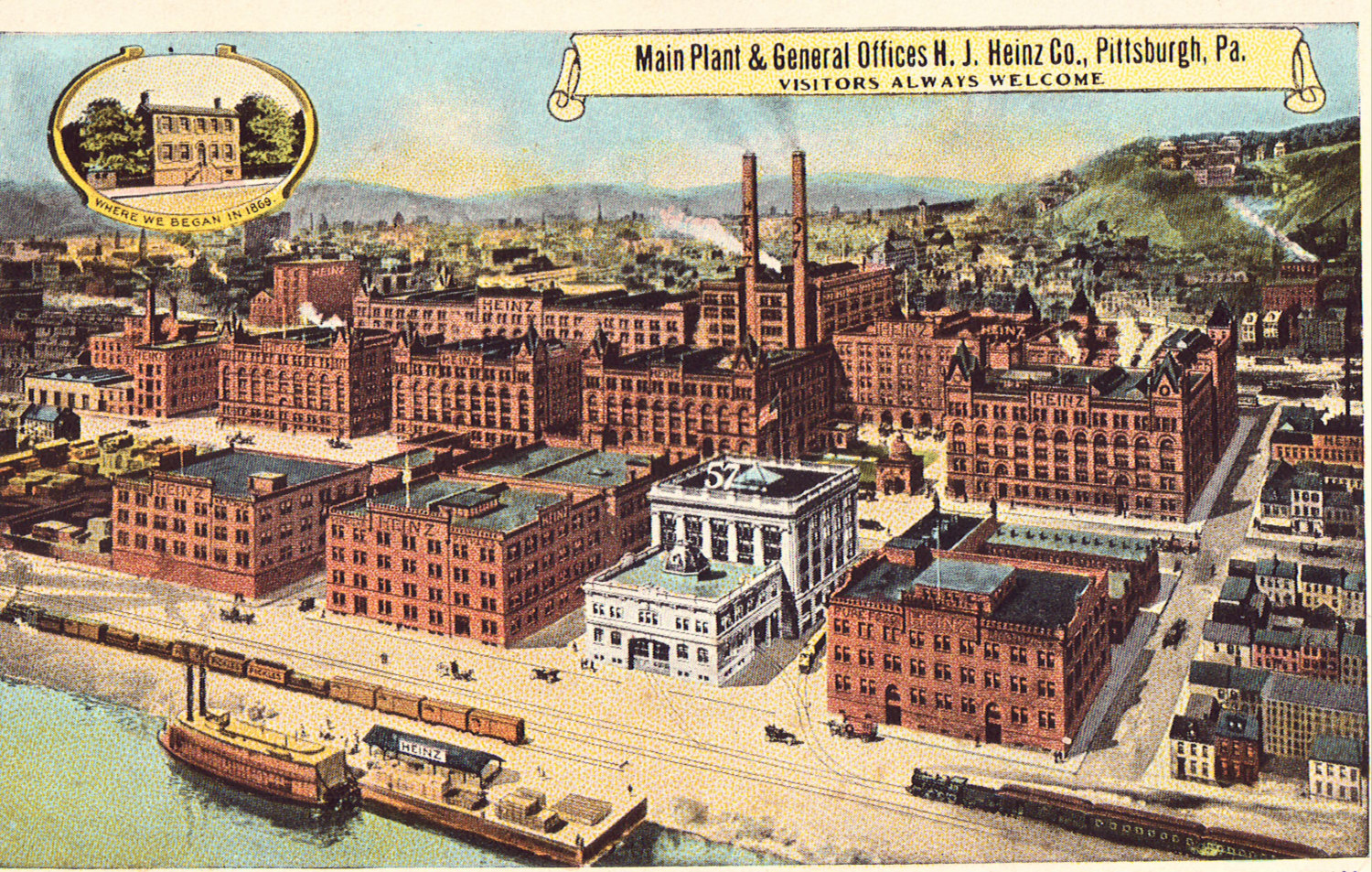
In the early 1870s, the H.J. Heinz Co. operated out of a two-story Sharpsburg farmhouse along the northern edge of Pittsburgh. They delivered their products by horse-drawn wagons.
Henry J. Heinz was born in Pittsburgh in 1844, of German ancestry. He began his life-long food business career -- not with pickles or ketchup -- it was with horseradish.
Heinz was still a boy when he began bottling and selling "Heinz Horse Radish" using a keystone-shaped label representing the Keystone State of Pennsylvania.
Henry J. Heinz on Horseback
Credit: Historical Society of Western Pennsylvania
In 1869 Heinz got married, and partnered in business with L.C. Noble. They bottled Anchor Brand food products at the Heinz homestead, which became their headquarters. Their quick growth of establishing branches in Chicago and St. Louis caused Heinz and Noble to go bankrupt in 1875. In 1876, Henry and two of his brothers "got back on the horse" and started all over again as F. & J. Heinz Company, getting their head-above-water financially in 1879.
In 1888 the company changed its name to H. J. Heinz Company and moved forward in building their "Heinz Complex" in Allegheny City, Pennsylvania. During this time, H. J. Heinz Company produced chili sauce, mincemeat, baked beans, tomato sauce, macaroni and
spaghetti with cheese, fruit butters, piccalilli, currant jelly, cherry and pineapple preserves, Worcestershire sauce, mustard dressing and other preparations. Presently, the Heinz Company manufactures thousands of food products in plants on six continents, and markets these products in more than 200 countries and territories.
The company has used its "57 Varieties" slogan since 1896, even though there were already at 60 products at that time.
The Heinz Company's distribution was well-known and recognized due to its elegance of delivery service. The horses were pure black Percherons, bred originally as warhorses rather than draft horses. The horse-drawn delivery wagon was usually painted white with green trimmings, carrying boxes of Heinz products.
Delivering Pickling Barrels, Pittsburgh, PA (1888)
Photo: From E. Willard Miller, Keystone to Progress, An Illustrated History
Windsor Publications (1986)
The quality of the horses was demanded in that the company's name was associated with the presentation of the delivery years ago, and then again in its exhibition hitch of recent years.
Heinz Hitch Postcard (1989)
The horses needed to be well taken care of, happy, well-shod and clean, bringing recognition to the brand name. Heinz demanded that his horses maintained a certain conformity in weight, size, type and color, and they were housed in his stables which were known as their "equine palaces."
H. J. Heinz Company had over 150 teams of Percherons operating out of its Allegheny City facilities. From 1894, Heinz Company shipped vinegar and pickles by means of rail.
Heinz was one of the first industrial employers of women who worked in a spotless factory. Their physical and moral welfare was carefully guarded, as "The Heinz Girls" had their medical and dental bills covered by the company.
Labeling Machine (1901)
Photo: Historical Society of Western Pennsylvania
Library & Archives, Senator John Heinz History Center
The Heinz Hitch was used for marketing and was seen in parades around the United States and Canada from 1984 (debuting at the Pittsburgh Labor Day Parade). Dalmatians (one was appropriately named "H.J." back in 2002) and "Susan Pickles," a bleary-eyed Basset Hound, accompanied the hitch throughout the exhibition years. The harness was handcrafted by the Amish in Central Ohio in patent leather with all chrome hardware and fittings, weighing approximately 74 pounds each set. Unfortunately, the company's officials announced in May 2007 that they could not keep spending $500,000 annually on a program whose marketing impact was difficult to measure.
"The decision to cease funding of the hitch was one that Heinz wrestled with for a number of years." With that, the company notified John Dryer (whose family owned the hitch operation and stabled the horses on its Washington County farm) and the sponsorship ended. Heinz agreed to fund the appearances already agreed to and on the books for 2007.
John Dryer
"Nothing lasts forever in this age." "I've been all over the world with the hitch, but my wife hasn't. It might be time to show her some of it."
Mr. Dryer worked for Heinz for 32 years, retiring in 1992 from his position as General Manager of Research and Product Quality Assurance.
Click and watch the Heinz Hitch exhibition at
Spruce Meadows in Alberta in 2003
Heinz History Center
Pittsburgh, Pennsylvania
The Heinz hitch wagon is a 6,800 pound antique Studebaker that traveled 57,000 miles a year over two decades promoting the Pittsburgh condiment-maker's products. The wagon was found uncovered in a roofless shed in central Pennsylvania in 1978 with a tree growing up through its bed. Built in Indiana in the 1850s, shipped to the east coast by rail, this same wagon hauled Heinz products around Philadelphia at the turn of the last century. Heinz purchased it in 1986, and two years later, spent $22,000 to have it refurbished by expert craftsmen. It took more than six months and 19 coats of paint on the initial refurbishment, and received only one more complete face lift in 1998. This heavy-duty hitch wagon served as the "tandem" trailer trucks of their time. Its home is now in The Senator John Heinz History Center, an affiliate of the Smithsonian Institution, and the largest history museum in Pennsylvania. The H. J. Heinz hitch "wowed" the crowds through the years at five Rose Bowl parades, the Calgary Stampede, and countless county fairs, exhibitions, Fourth of July and other holiday parades.
Horse Drawn Caisson at Arlington Cemetery
Passing Christmas Wreaths
Photo: Don Harper
In August of 2007, The H.J. Heinz Company formally announced that it would donate its hitch horses to the 3rd U.S. Infantry Regiment (The Old Guard) where they were used to pay homage to fallen soldiers (and former Presidents and other statesmen) at Arlington National Cemetery. This ensured that the horses would be well cared for throughout their lifetime as they participated in some of the eight full-honor military funerals per day in Arlington while living at Fort Myer, adjacent to the cemetery.
Fort Myer, Virginia traces its origin as a military post to the Civil War. In 1887, Gen. Philip H. Sheridan, the Army's commanding general, decided Fort Myer should become the nation's cavalry showplace. The cavalrymen moved in, including the 3rd Cavalry Regiment, supported by the 16th Field Artillery Regiment, and the communications people moved out. Fort Myer became home to as many as 1500 horses from 1887 to 1949, and horse care was of utmost importance then and now.
All of the horses at Fort Myer have a full-time dedicated caretaker and veterinarian, and more than 40 other horses for company. Those other horses in the stable have various honor duties, including taking part in therapeutic riding programs for injured military personnel.
In February 2013, the Heinz Company was eventually sold to Warren Buffet's Birkshire Hathaway and 3G Capital for $23 billion dollars. Other product lines that you might recognize and might not know are Heinz products include: HP Sauce, Lea and Perrin's sauce, Ore-Ida and Tater Tots potato products, TGI Friday's, Weight Watchers, and several others brands.
On an interesting note: For many years, Heinz supplied McDonald's with ketchup. In October 2013, McDonald's ceased this relationship after 40 years, and decided to transition business to other suppliers. This was due to the then-recent management changes where 3G Capital (part-owner of Burger King) / Heinz hired the former Burger King CEO, Bernardo Hees, as president of Heinz. However, many McDonald's locations overseas still use Heinz Ketchup.
"To do a common thing uncommonly well brings success." ~ H.J. Heinz
A motto to strive to live by, here at Eaglesfield Percherons.