Saturday, June 27, 2015

We're Celebrating . . .


That Percherons come in more colors than you thought.

.•°*”˜˜”*°•.˙·٠•● Ƹ̵̡Ӝ̵̨̄Ʒ ●•٠·˙.•°*”˜˜”*°•.


Saturday, June 20, 2015

Happy Father's Day ~ Eaglesfield Brigadier


Father's Day is a time that we reflect upon and celebrate
our Eaglesfield Brigadier's presence and progeny.

We love this tried and true stallion who is,
and has sired, the quality of Percheron we love.
Happy Father's Day Brig!


Champion Percheron Stallion at 3 (2011)


Eaglesfield Brigadier (M28622)
April 25, 2008
Rose Hill Bud (M22652) x High Hope Heather (F34557)

•.¸✽✽¸.•

Tuesday, June 16, 2015

Draft Horse Training Camp a la Eaglesfield


Thank you, Courtney Stephenson, for your blog post on what it takes to get a Six Horse Hitch ready to compete at the Calgary Stampede.  Our own spring training camp helps us identify potential teams of horses that work well together . . . and they might as well work during this process to help us get some chores done.  Click the photo above to read more about this very important training process.


Wednesday, June 10, 2015

Brilliant 1271 and Oaklawn Farm

Brilliant 1271 in 1890
Imported to Oaklawn Farm from
France by M.W. Dunham in 1881

Brilliant was Mark Dunham's most valuable sire that stood for Oaklawn Farm in Wayne, Illinois for 15 years.  He was described in Oaklawn's catalog in 1892 as, "Weight 1,850; 16 hands high, long and very round body; extraordinary length of quarters, which are broad and level; very sloping shoulders of unusual depth; neck rather short; medium throttle; fine ear; wide between the eyes; slightly Roman nose; very broad breast; short legs and bone of uncommon width; good feet; immense stifle power."  Another description written during that time references the stud as follows: "Brilliant 1271 was a most impressive horse in his general bearing, and masculine character was emphasized in every line.  He was a dominant, vigorous, supermasculine stallion and no one could possibly mistake his power."

The Thunder Storm
Brilliant 1271 with Some of his Progeny
Artist:  Frank Whitney, Commissioned by Dunham


Up until the 1880s, most people did not know that black Percherons existed since the majority in the United States were grey.  During this time, black Percherons became somewhat of a fashion statement, thus lending popularity to Brilliant as a stud.

Ernest Perriot stood out as the greatest constructive Percheron breeder in the late 1870s at the farm of La Chenelière 
near Nogent. Perriot provided Dunham first option on all his best horses for export for many years.  There was a close friendship with mutual respect and loyalty between Dunham and Perriot.  It has been said that there was approximately $350,000 exchanged for Percherons for Oaklawn Farm between the parties.  Until Oaklawn was done examining and acquiring Percherons, no one could have a chance at the Perriot "top-of-the-line" horses.

Dunham Castle at Oaklawn Farm was placed on the U.S. National Register of Historic Places in 1979, and was under restoration in 2009.  The Oaklawn estate originally had 2000 acres but now only 56 remain, along with nine buildings which have been utilized by the Dunham Woods Riding Club for years.  As many as 500 Percherons were stabled on this property at one time.


Mark W. Dunham died in 1899, reportedly of blood poisoning after inspecting an infected hoof.  An unfortunate end for one of the most notable Percheron breeders of all time.


Friday, June 5, 2015

2015 Calgary Stampede Poster Art

Thundering Chuckwagon at Stampede
Artist:  Oleg Stavrowsky

For 100 years, the Calgary Stampede has been creating posters for their event, originally as a prime form of promotion.  Read about this beautiful artwork by one of the first contemporary western artists to become a member of the Russell Skull Society of Artists by clicking the photo above.

We cannot wait to be a part of the Calgary Stampede in 2015!


Friday, May 15, 2015

New Edibles for the 2015 Calgary Stampede


Yet another reason to look forward to Stampede Days. . . . Thank you Stampede Blog for giving us the heads up on the smorgasbord of delicacies -- and those of possibly avoidable interest!!  Click on the luscious Mini Donut Pops for more details on these frozen delectable edibles and the other 27 . . .

•.¸✽✽¸.•

Thursday, April 30, 2015

"One Man's Trash is Another Man's Treasure"


Pegasus

When artists pick through scrap and trash, piquing their creative juices, we love to see the transformation into industrial art.  Hasan Novrozi is another of our metal favorites who was born in the Czech Republic in 1981.


An aficionado of cars, an occasional motorcycle racer and full time bike mechanic, Novrozi loves working with steel and learned that he loves welding the scrap parts together more.


The intricacies of the machinework brings to life bone structure, muscle, feather and hair.


Novrozi wanted his Pegasus to evoke wonder and awe, as the steed of Poseidon (the god of the sea) would command.


We look forward to seeing some of Novrozi's pieces exhibited in the United States and Canada.

Click below for a slideshow of Novrozi's work. 


.•°*”˜˜”*°•.˙·٠•● Ƹ̵̡Ӝ̵̨̄Ʒ ●•٠·˙.•°*”˜˜”*°•.

Monday, April 6, 2015

The Final Days of The Transcontinental Travels of The Caravan


Gerard Paagman and his family (in their trademarked orange attire) from Invermere, British Columbia, with their House of the Friesians horses, joined up with friends in Murrieta, California. On November 1, 2014, this small group of friends and their horses set out for the east coast.  They were joined along with the way by other passionate travelers, and together they made their way across the southern United States. Some would join up for only a weekend or a set distance getting to have a brief taste of the experience only to make them want more.  On March 14, 2015, with a lot of congratulatory fanfare, the Caravan arrived at the beautiful Grand Oaks Resort in Weirsdale, Florida, the weekend before the start of the popular Live Oak International CDE in nearby Ocala.


The weather was somewhat kind to the group traveling in the dead of winter; temperatures ranged some 40-50 degrees as they traveled along the way.

The Paagmans' Friesians were the flashy-working stars of the Caravan who drew the attention of many as each put in their own honest-day's work.  In the fall of 2012, nine of the family's much-loved Dutch-bred horses headed to the southeast to film their part in "the Parade of Tributes" for the movie: The Hunger Games:  Catching Fire" in Atlanta, Georgia.

The kindnesses experienced by The Caravan from overnight hosts, as well as entire towns did not go unnoticed.  Holiday parades and celebrations that were taking place as the group made their way across the U.S. immediately opened their arms for their participation.  Invitations for dinner, overnighting and educational show-and-tells for local school children made this journey a heartfelt experience for everyone.

The video above catches some of the activities of The Caravan's final days.  We hope you enjoy it as much as we have.

•.¸✽✽¸.•

Tuesday, March 24, 2015

Eaglesfield Eagle Eyeing 2015

It's that time of year again for eagle eyeing via webcam in the southeastern United States at Berry College. The nest is situated in eagle-eye view of Berry's main entrance and the parking lot of their athletic and recreation center. The eagles do not migrate due to plentiful food available from nearby lakes, and the Oostanaula River.  In 2013, the eagle couple successfully produced two eaglets; 2014, one eaglet, and for 2015, we welcomed the hatching of an eaglet on February 13th and another on February 15th.  Click on the photo below to access the live eagle webcam, day or night, to check on the progress of these beautiful babes.


The term for "Eagle" is derived from Latin: aquila by way of French: aigle . . . which, through other derivatives, means "dark-colored, swarthy, or blackish" as a reference to the bird's plumage  . . . or fromaquilo, meaning "north wind." Thus, our name "Eaglesfield" fits quite nicely given all the black horses and north winds we are fortunate enough to experience.  

.•°*”˜˜”*°•.˙·٠•● Ƹ̵̡Ӝ̵̨̄Ʒ ●•٠·˙.•°*”˜˜”*°•.

Friday, March 13, 2015

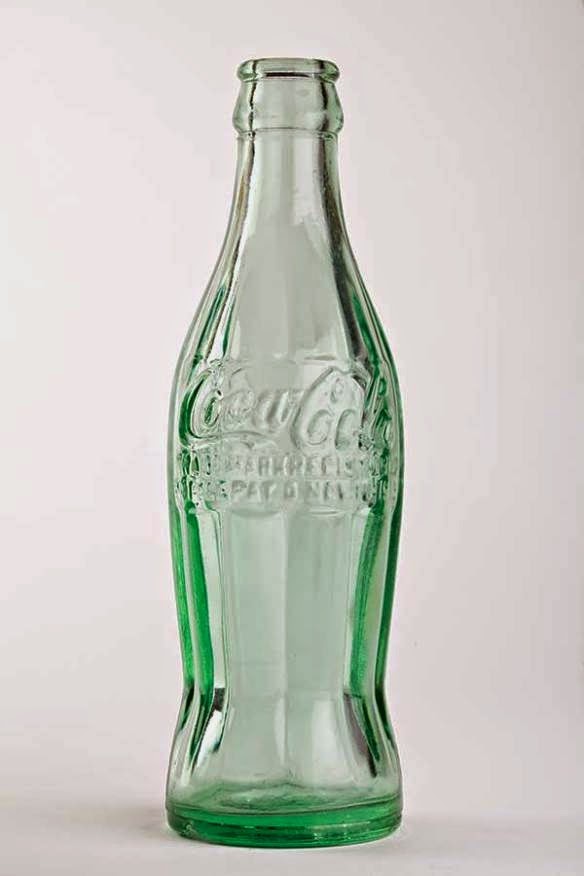
The Iconic "Georgia Green" is 100 Years Old


1915 Patent Coca-Cola Contour Bottle, 1916
Collection of and (c) The Coca-Cola Company

The Coca-Cola Company put out a call for a new bottle design in 1915.  The Root Glass Company is located in Terra Haute, Indiana. Root received the Coca-Cola's brief, and President Chapman J. Root sent bottle designer, Earl R. Dean, and auditor, Clyde Edwards, to a local library to get their creative juices flowing.  


The two gentlemen believed that the coca leaf and kola nut were two main ingredients in Coca-Cola, and sought to find images of these items.  They were not successful.  However, they did stumble upon an illustration of a cocoa pod in the Encyclopaedia Britannica . . . the pre-internet source of all information.   Even though cocoa is not an ingredient of Coca-Cola, Root Glass utilized its pod-shape and ribbed exterior into their original bottle design.

Photo Credit:  Carl Frank/Photo Researchers
Encyclopaedia Britannica

The Root Glass Company of Terre Haute, Indiana was the winner of the 1915 bottle competition. This distinctive and unique package for Coca-Cola was developed into the recognizable, narrower form and patented in November 1915 (top photo, above), and was put into production in 1916.  

To celebrate the birth of one of the world's most recognized icons 100 years ago, an exhibition opened on February 28, 2015, at the High Museum in Atlanta, Georgia, home of The Coca-Cola Company. 


Ansel Adams in a Truck (1953)
Artist:  Imogen Cunningham (1883-1976)
Collection of Joyce Linker
(c) 1953, 2015 Imogen Cunningham Trust

The second floor of the High Museum features three main areas: Design History of the Bottle; Pop Art, featuring more than 15 works by Andy Warhol; and Photography, tracking the iconic Coca-Cola bottle within the ever-changing cultural landscape of 20th and 21st century America.  This exhibition closes October 4, 2015.

Three Coke Bottles (1962)
Artist:  Andy Warhol (1928-1987)
Silkscreen, ink, and graphite on linen
The Andy Warhol Museum, Pittsburgh
Founding Collection, Contribution The Andy Warhol Foundation for Visual Arts, Inc. 1998.1.20
(c) 2015 The Andy Warhol Foundation for the Visual Arts, Inc. / Artists Rights Society (ARS), NY

The term "Georgia Green" was used to name these famous Coca-Cola contour bottles until 1956, tipping the hat to Coke's home state.  The green tint of the bottles was caused by impurities of the glass with iron oxide.  It seemed that it was too expensive at the time to use quartz sand that is free of impurities or it was not a technical standard to add dye removers.    


Click above to visit the efforts to build the exhibition, 
The Coca-Cola Bottle:  An American Icon at 100
High Museum, Atlanta, Georgia

Thursday, February 26, 2015

Adrian Landon's Galloping Mechanical Horse

Mechanical Horse
Artist:  Adrian Landon (1989 -     )
Current Exhibition:  The Winter Equestrian Festival
Wellington, Florida
Photo Courtesy:  AdrianLandon.com

Adrian Landon of  Brooklyn, New York, sculpts to express his urge to reconnect with his family heritage with his favorite subject of inspiration, horses.  Landon's father and grandfather were expert horsemen. His grandfather commanded the French military training establishment at Saumur, The Armoured Cavalry Branch Training School.

Photo:  Saumur - École de Cavalerie - Caserne grille by Pymouss

Landon grew up in New York City and attended the Lycee Francais de New York.  After a year of industrial design at the Academy of Art in San Francisco and traveling all over the United States, he returned to New York in 2009 to join artists at the Arts Students League.

Cheval en Bronze
Photo:  Valerie Penven

His method of his sculpting is known as "repousse" where flat pieces of sheet metal are hand forged with anvil and hammer.

Galloping Horse 2

Since he began his work in 2010, Landon has sculpted more than 10 equine pieces, and spent more than a year planning on how to make the horse "real."  Click the video below to see his "real" kinetic Mechanical Horse galloping along (happily) right now in the warm weather of Wellington, Florida.  [You may want to take advantage of full screen viewing by clicking the lower right corner of the video.]

Mechanical Horse

.•°*”˜˜”*°•.˙·٠•● Ƹ̵̡Ӝ̵̨̄Ʒ ●•٠·˙.•°*”˜˜”*°•.


Tuesday, February 24, 2015

Thursday, February 12, 2015

Got Snow?


Under the microscope, I found that snowflakes were miracles
of beauty; and it seemed a shame that this beauty should not be 
seen and appreciated by others.  Every crystal was a masterpiece
of design and not one design was ever repeated.  When a snowflake
melted, that design was forever lost.  Just that much beauty was gone, 
without leaving any record behind. ~ Wilson "Snowflake" Bentley (1925)


Wilson Alwyn "Snowflake" Bentley
is one of the first known photographers of snowflakes.


He perfected a process of catching flakes on black velvet and blackboard in such a way that their images could be captured before they either melted or sublimated.


Bentley removing emulsion from a glass plate.


Bentley was first interested in snow crystals as a teenager on 
his family farm in Vermont.  He tried to draw what he saw through an old microscope given to him by his mother when he was 15.  


Since the flakes and crystals were so complex, Bentley couldn't record them properly before they melted.  He attached a bellows camera to a compound microscope.  After an extensive number of attempts, he finally photographed his first snowflake on January 15, 1885.  As a self-taught scientist and artist, whose singular obsession with the snowflake's infinite variety, his interests extended to how it was formed.

 During Bentley's lifetime, he captured more than 5,000 images of crystals.       

Wilson Bentley (1902)

 Bentley referred to snowflakes as "tiny miracles of beauty" 
and snow crystals as "ice flowers."

 Bentley published an article wherein he argued that 
no two snowflakes were alike.  This concept caught the attention of many
including The Smithsonian, National Geographic, Nature, Popular Science, and Scientific American.

Bentley Snowflake Micrograph (1890)

Wilson Bentley died of pneumonia at his farm in December 1931, after walking six miles in a blizzard.  Shortly before his death, his book, Snow Crystals, was published by McGraw/Hill and is still in print today.

" . . . Bentley was working with crude equipment . . .
But he did it so well that hardly anybody bothered to photograph snowflakes for almost 100 years."
~ Kenneth G. Libbrecht

Despite Bentley's fascinating work that led to significant contributions to science and photography, his name remains largely unknown to the public.  However, in Bentley's hometown of Jerico, Vermont, he is a household name.  A museum is dedicated to his life's work at an old mill that houses approximately 2,000 of his vintage images.  


Click HERE to visit the Wilson Bentley Museum
and his ability to capture "magic."

Snow in Canada

And to think you had your fill with snow this season . . . .

Sandra Boynton's Snowflake